Open an Argentine league table and you may find two separate standings rather than one. Boca Juniors might be listed in Zona A, River Plate in Zona B, and both can be competing in the same tournament without ever meeting in the group stage as ordinary opponents. This structure confuses many international fans. Why are there two tables? Are the zones separate divisions? How do clubs move between them? And how does any of this decidewho becomes champion? This guide explains what the zones are, why they exist, how clubsare assigned, how many matches each team plays, who qualifies for the playoffs, and howthe zone tables interact with the season-long Tabla Anual.
The quick explanation
Argentina’s 30 top-flight clubs are divided into two parallel groups of 15. Each club plays theother 14 teams in its zone, one traditional rival from the other zone and one additionalinterzonal opponent. The top eight teams in each zone reach the knockout stage, whereclubs from Zona A face clubs from Zona B.
● 30 clubs
● 2 zones
● 15 clubs per zone
● 16 regular-phase matches
● 8 qualifiers from each zone
● 16 teams in the playoffs
Zona A and Zona B are not separate divisionsThis is the most important point to understand. Zona A and Zona B are not different leaguesor hierarchical levels. They are two parallel groups inside the same tournament.There is nosporting ranking difference between the zones. Finishing first in Zona A is not inherentlybetter than finishing first in Zona B. Both zones send eight teams into the same knockoutstage, and the eventual champion can come from either group. The letters A and B simplylabel the two groups. They do not mean first division and second division.
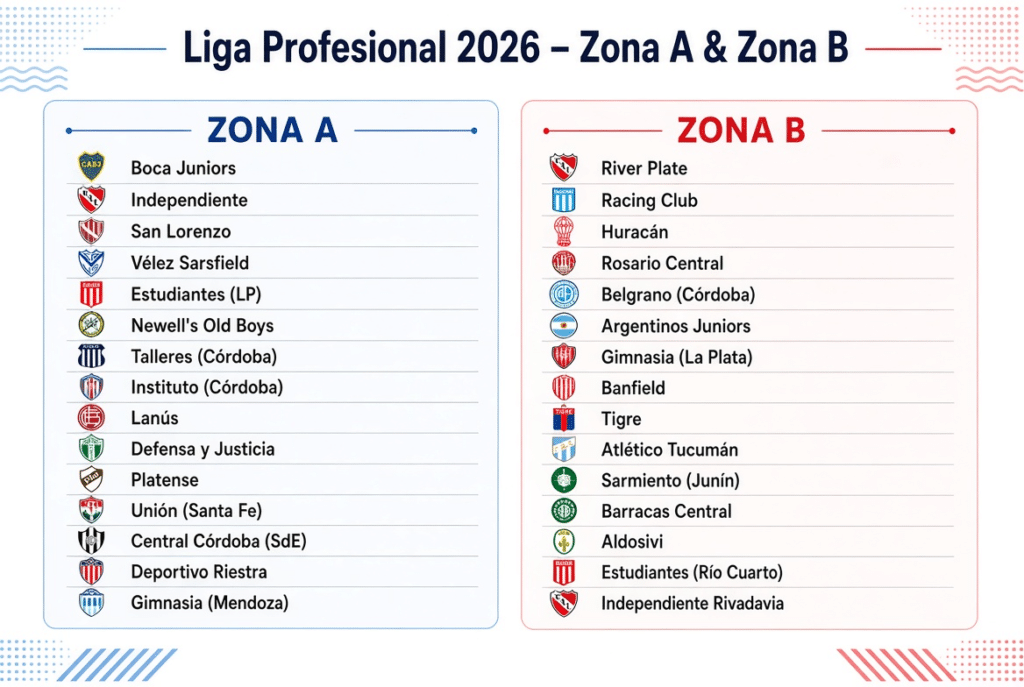
Above: This years zones
Why does Argentina use two zones?
With 30 clubs in the top flight, a traditional double round-robin would require an extremelylong schedule. The zone system allows the Liga Profesional to run a shorter regular phasewhile still fitting two complete tournaments — Apertura and Clausura — into one calendaryear.The format also makes it easier to protect major rivalries. Traditional clásicos arescheduled as interzonal fixtures so that the biggest matches still take place even though theclubs sit in different groups. Practical factors such as geography, stadium availability,security and television scheduling also influence how the zones are organised. In short, thezone system lets the league manage a large number of clubs, preserve important derbiesand produce two champions within the same year.
How are the clubs assigned to each zone?
The process follows three main steps. First, clubs are organised into pairs. These pairs oftenreflect traditional rivalries or practical considerations such as geography and security.Second, one club from each pair is placed in Zona A and the other in Zona B. Third, the finalassignment is completed through a draw, with some adjustments for logistics andbroadcasting.
The simplest example is Boca Juniors and River Plate. They are deliberately kept inopposite zones so that the Superclásico can be played as an interzonal fixture rather thanbeing lost inside one group.
How many matches does each team play?
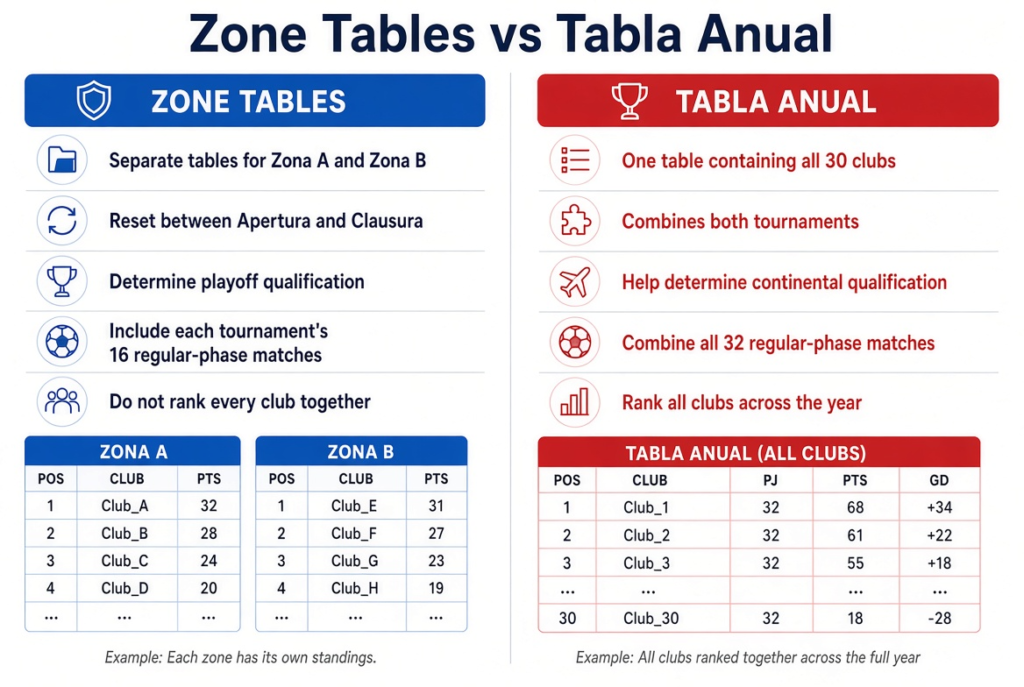
Fourteen matches inside the zone. Every club plays the other 14 teams in its own zone once. These matches form the bulk of the regular phase and decide most of the points that appear in the zone table.
The clásico interzonal
Each club also meets its traditional or assigned rival from the opposite zone. These fixturesinclude the Superclásico (Boca vs River), the Clásico de Avellaneda (Independiente vsRacing), San Lorenzo vs Huracán, Estudiantes vs Gimnasia, and Newell’s vs RosarioCentral, among others.
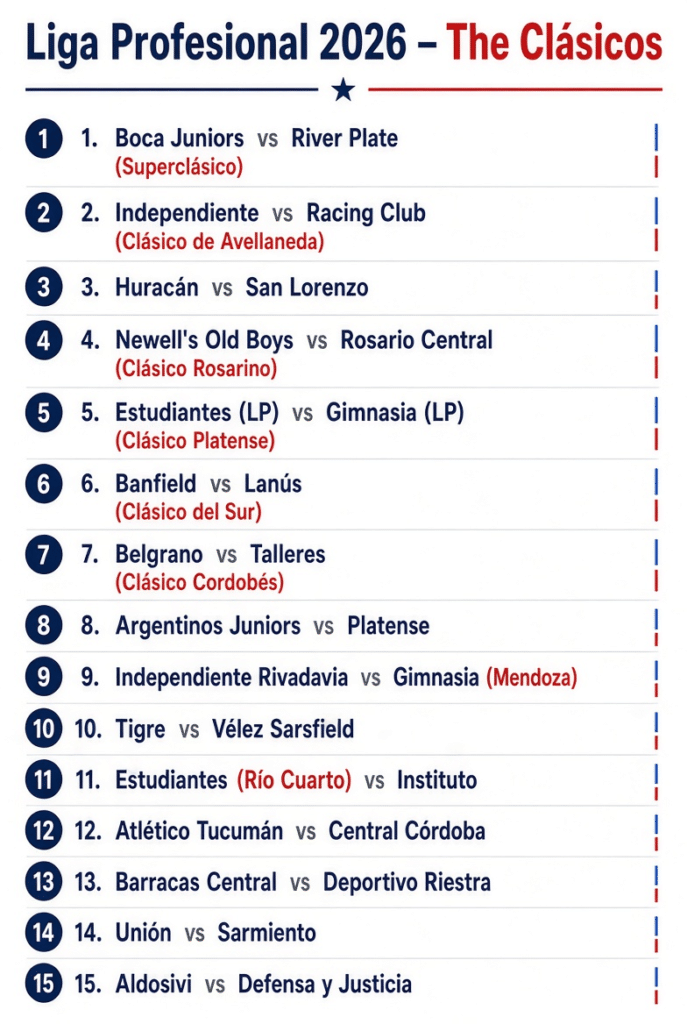
Above: All the interzonal clasicos this season. Some more intense and historical than others.
The additional interzonal fixture
Finally, each club is drawn against one extra opponent from the other zone. These matchescomplete the schedule. In total:
● 14 same-zone matches
● 1 clásico interzonal
● 1 additional interzonal
● = 16 matches
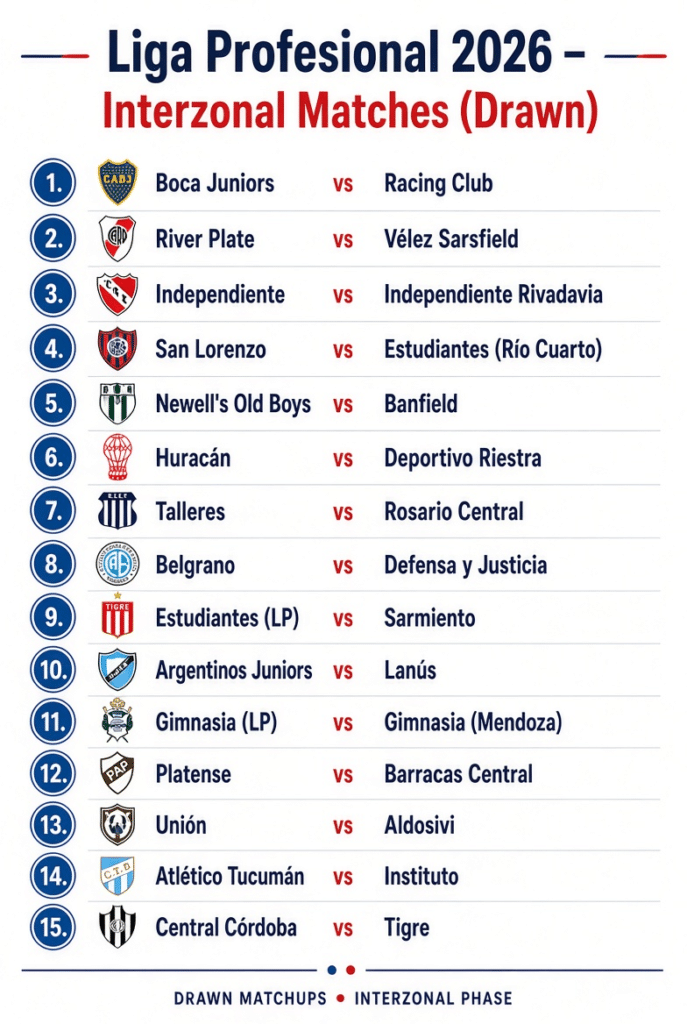
Above: The more or less random interzonal matches for this season.
Why is there an interzonal match almost every round?
Because each zone contains 15 teams, an odd number, it is impossible for every club to playa pure zone match in the same round. Fourteen teams in Zona A can form seven matches,leaving one club free. The same happens in Zona B. The two remaining clubs then faceeach other in an interzonal fixture so that all 30 teams are in action.In addition, the scheduleincludes one complete round made up only of the extra drawn interzonal matches.
How do the two zone tables work?
Each zone keeps its own table. Points are awarded in the standard way: three for a win, onefor a draw and zero for a defeat. All 16 regular-phase matches count toward the zonestanding.Final position in the zone table decides both qualification for the playoffs andseeding. Higher-placed teams receive home advantage in the early knockoutrounds.Tie-breakers (in order): goal difference, goals scored, head-to-head results, andfurther criteria set by the regulations if needed.
How teams qualify for the playoffs
The top eight clubs from each zone advance, producing a 16-team knockout stage. Thepairings cross the zones: Meaning that the winner from Zone A meets the lowest ranked(8th)team from Zone B. The corresponding pairings from the other side complete the round of 16.All knockout matches are single-leg. The higher-ranked club hosts until the final, which isplayed at a neutral venue.
Why finishing first matters
Finishing top of a zone brings clear advantages. The first-placed team faces theeighth-placed side from the opposite zone and hosts the round-of-16 match. If that clubcontinues to progress, its superior regular-phase ranking also gives it home advantage inlater rounds against lower-seeded opponents.Finishing first does not make a club champion.The title is decided only in the knockout stage.
How Apertura and Clausura use the zones
In 2026 both tournaments use the same Zona A and Zona B. The match pairings remain the same, but home and away venues are reversed in the Clausura. Each tournament has itsown zone tables and its own playoff, and each produces its own champion.
see: Apertura and Clausura Explained:
Is the zone system fair?
The format has clear strengths. It produces shorter tournaments, keeps more clubs incontention for longer, protects major derbies, rewards higher regular-phase finishes withhome advantage, and creates a full knockout stage.It also has limitations. The two zonescan differ in overall strength, clubs do not face exactly the same opponents, the drawninterzonal matches can vary in difficulty, 16 of the 30 clubs reach the playoffs, and the bestregular-phase side is not automatically the champion.These are structural trade-offs rather than simple strengths or weaknesses.
The system favours entertainment over direct fairnessas it is more likely to get unpredicted winners in a system in which a more than half of thedivision goes through to a single legged knockout phase. But that is what gives the smallerteams a fighting chance against bigger clubs with budgets on a whole other level. The factthat there are two opportunities per calendar year to achieve something great is also anadvantage for both neutral viewers and fans of the smaller clubs.But this chase for entertainment and unpredictability nationally is part of the problem forArgentina’s recent troubles in international tournaments.
One important Clausura exception
Important 2026 rule. A club that is in a relegation position or involved in a decisive relegation match cannot takepart in the Clausura playoffs, even if it finishes in the top eight of its zone. Its place passes to the next eligible club in the same zone table.